
Understanding Toyota Safety Sense 3.0
A Guide to Advanced Driver-Assist Technology
For drivers in Tustin, CA, and nearby communities like Anaheim, Orange, and Huntington Beach, safety technology has become a deciding factor when choosing a new vehicle. Toyota Safety Sense 3.0 (TSS 3.0) represents the latest evolution of Toyota’s active safety suite, combining refined sensors, cameras, and advanced software into a comprehensive platform designed to help prevent accidents and support confident driving across a range of real-world conditions.
TSS 3.0 is standard on most 2026 Toyota models, reinforcing Toyota’s commitment to making advanced safety accessible rather than optional. Whether you’re commuting through Orange County traffic or navigating suburban neighborhoods, this system works quietly in the background to enhance awareness and help reduce collision risk.
Core Features of Toyota Safety Sense 3.0
TSS 3.0 uses a forward-facing camera paired with millimeter-wave radar to continuously monitor the road ahead. These sensors work together to detect vehicles, pedestrians, bicyclists, and environmental factors like road curves and traffic signs. Here’s what the suite includes:
Pre-Collision System with Pedestrian Detection
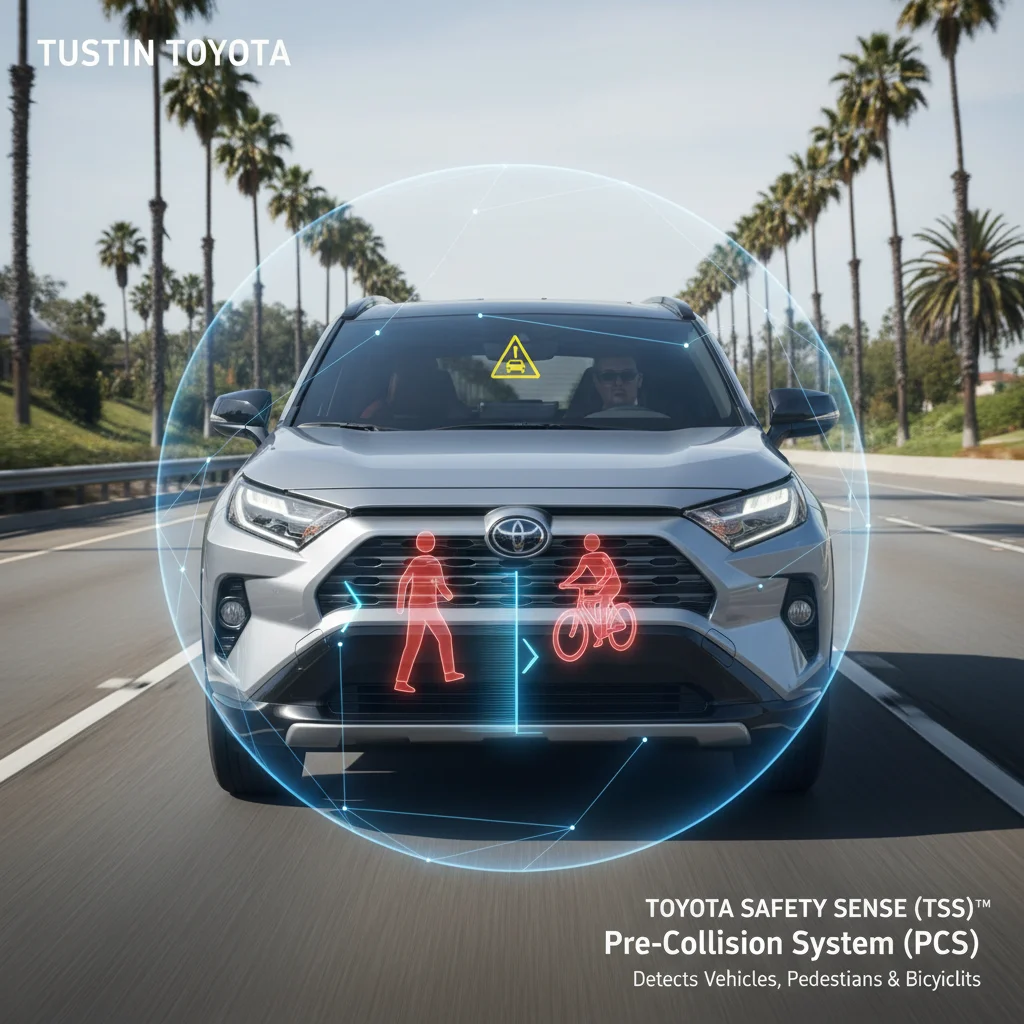
The Pre-Collision System (PCS) detects potential frontal collision threats involving vehicles, pedestrians, and bicyclists. When a hazard is identified, PCS alerts the driver with visual and audible warnings. If the driver doesn’t respond, the system can apply automatic emergency braking to reduce impact severity or help avoid the collision. TSS 3.0 expands detection to include bicyclists during both daytime and low-light conditions — a meaningful upgrade for drivers navigating busy intersections and school zones in areas like Anaheim.
Dynamic Radar Cruise Control with Curve Speed Reduction
Dynamic Radar Cruise Control (DRCC) maintains a safe following distance from the vehicle ahead by automatically adjusting speed, including coming to a complete stop and accelerating again in traffic. For 2026, the system integrates curve speed reduction, which detects upcoming bends and gently reduces speed before entering them. This is particularly useful on winding suburban roads near Corona and during stop-and-go commutes on Orange County freeways.
Lane Departure Alert with Steering Assist
When the system detects unintended lane drifting at speeds above 30 mph, it alerts the driver through visual and audible cues. Steering Assist applies gentle corrections to guide the vehicle back toward the center of the lane. Road Edge Detection adds another layer by identifying lane boundaries even when markings are faded or absent — a common reality on older roads throughout Southern California’s suburban areas.
Lane Tracing Assist
Working in tandem with Dynamic Radar Cruise Control, Lane Tracing Assist (LTA) helps keep the vehicle centered in its lane by providing continuous steering inputs. LTA reads lane markings and the path of vehicles ahead, reducing steering workload during extended highway drives. This feature is especially helpful on congested freeways between Tustin and Irvine, where maintaining lane position consistently reduces fatigue and supports safer driving.
Road Sign Assist
Road Sign Assist (RSA) uses the forward-facing camera to detect and display critical traffic signs — including speed limits, stop signs, and yield signs — on the vehicle’s instrument display. This real-time feedback helps drivers stay informed, particularly when navigating unfamiliar routes or school zones in Tustin and Costa Mesa where posted limits change frequently.
Automatic High Beams
Automatic High Beams (AHB) optimize nighttime visibility by automatically switching between high and low beams at speeds above 21 mph based on oncoming traffic detection. This eliminates the distraction of manually toggling headlights and improves sightlines on less illuminated roads around Huntington Beach and other coastal communities.
Proactive Driving Assist: Anticipatory Collision Avoidance
One of the most significant additions exclusive to TSS 3.0 is Proactive Driving Assist (PDA). Unlike systems that react only when a collision is imminent, PDA takes an anticipatory approach — monitoring the road ahead and providing gentle braking or steering inputs to help prevent hazardous situations from developing in the first place.
PDA operates at approximately 20 to 35 mph and can detect pedestrians, cyclists, other vehicles, and parked cars. When it senses a potential risk, the system may gently reduce speed to maintain a safe buffer, even if the driver is still pressing the accelerator. If a vehicle merges closely ahead, PDA can apply light braking to maintain following distance, giving the driver additional time to respond.
The system also includes curve braking capability. When PDA detects that the vehicle is approaching a bend at a speed that could compromise stability, it initiates gentle deceleration and displays an alert on the instrument cluster. Additionally, PDA dynamically adjusts steering effort based on conditions — increasing resistance on straight roads to prevent minor drifting, and modulating force through curves for smoother handling.
It’s important to note that PDA is designed to assist, not override. The system provides support while leaving ultimate control with the driver — a balance that reflects Toyota’s philosophy of enhancing safety without diminishing driver engagement. PDA’s effectiveness depends on factors including speed, lighting, and weather, which is why attentive driving and regular system maintenance remain essential.
For families driving through school zones in Tustin or navigating the changing traffic patterns near Irvine, PDA offers an additional layer of protection that can provide crucial seconds for the driver to respond to unexpected situations.
What TSS 3.0 Doesn’t Include — And What Complements It
It’s worth clarifying that some commonly referenced safety features are not part of the TSS 3.0 suite itself. Blind Spot Monitor (BSM) and Rear Cross-Traffic Alert (RCTA) are separate Toyota safety systems that come standard or available depending on model and trim level. These features use rear-mounted sensors to detect vehicles in blind spots and alert drivers to cross-traffic when reversing — valuable complements to TSS 3.0, but distinct from it.
When shopping for a new Toyota, it’s helpful to understand this distinction so you can evaluate which models include both TSS 3.0 and BSM/RCTA in your preferred trim configuration.
Keeping Your Safety Systems Performing at Their Best
Toyota Safety Sense 3.0’s sensors and cameras require proper maintenance to function optimally. Clean windshields, properly calibrated sensors, and regular system inspections are essential — particularly after windshield replacement or collision repairs. Staying current with maintenance ensures these systems deliver the protection they’re designed to provide throughout the life of your vehicle.
Explore Toyota Safety Sense 3.0 at Tustin Toyota
For drivers in Tustin and surrounding Orange County communities ready to experience TSS 3.0 firsthand, Tustin Toyota offers a comprehensive selection of new Toyota models equipped with the latest safety technology. Our team can walk you through each system’s operation and help you find the right vehicle for your needs.
Browse our new Toyota inventory to explore available models, or call our sales team at 714-909-2159 to schedule a test drive. Visit us at 36 Auto Center Dr, Tustin, CA 92782.
0 comment(s) so far on Understanding Toyota Safety Sense 3.0